View Comments

Did The Interweb Kill Weird Al?

Posted by 40deuce on 8:21 PM in , , , ,

No, Weird Al isn't really dead. Your geeky mind can rest at ease.

I was having a conversation the other day about Weird Al with a couple friends about how we used love him. He was a huge part of so many of my friends' childhoods. But, where is he now?

He's still putting out records (he had one last year. I looked it up on Amazon to be sure), but how many people are listening to them? I was surprised to even see that he's still doing music (No offense Al). How many kids these days know the genius that is Weird Al? Probably not a lot. Why do you think this is? I'll tell you why: the internet.

Back when Weird Al was a big deal, things like music sharing and YouTube didn't exist. Weird Al got a record deal for being the best parody artist around. He was signed to a real record label and had world-wide major distribution of actual physical products (remember when music came like that?). This is how music got to the masses not too long ago.

The internet changed all that. Now any yahoo with some kind of device that records can create a parody song and upload it to the interweb for the whole world to see. You don't even need musical talent anymore. People are making funny songs and putting them on the internet at an alarming rate. It's hard for anyone to really stand out amongst the crowd of "parody artists" on the net. Something that's hilarious one day is old news and forgotten the next. Remember this one:


Probably not. But that's my point.

Songs don't even need to parody other songs anymore. They can parody real life situations caught on tape now also. Look how popular the "bed intruder" guy is! This song is iTunes for gods sake:


The point is old channels of distribution are dying. Everyone talks about paper is dying because of the internet, but it's not the only thing. Everything that used to get distributed physically is completely changed due to the internet. And if they haven't, they better or they could get left behind.

The days of the international parody artist may behind be us, but I am enjoying all the little stars that pop up every day.

Also, I still love you Weird Al!


View Comments

The Speed of Social


This weekend Mitch Joel posted a fantastic article entitled "The Real Time Web is a Big Problem for the Web". In it he talked about how when things spread in real-time, like say over Twitter, it's not always the easiest to keep up. He used the story of how a plane had crashed and someone in the vicinity tweeted about it right away. Mitch saw the tweet and immediately checked CNN's website, but there was nothing about it there.

In today's society where we're exposed to information at a constant and quick pace through things like social media, instant messaging and cell phones that we expect everything else to be keeping up with us. Is that really possible?

In Mitch's case, a big news outlet like CNN has to hear about a story, do some research on the topic (even if that's just checking if said story is even really happening), write something up, edit it, get approval, send it to their guy that puts stories up on the site and then publish it before any of us common folk get to see it.

Mitch isn't alone with this problem. Tons of people, myself included, think of something and then expect instant gratification. Unfortunately the world doesn't always work like that.

I remember when I was young and I had a question, I had to wait to got home and then hope I still remembered the question. Then I could try and look it up in an encyclopedia and even then it wouldn't always hold my answer. A few years later the internet came around and if I could remember a question by the time I got home I could then google it. Now, I carry around an iPhone and when I have a question I can pull my phone out of my pocket and look up an answer instantly. Everything should be like that, right?

I work and talk a lot about brands monitoring social media for people talking about them. I wholeheartedly believe that they should be doing this and respond to a comment or join a conversation when they can. The problem is when we're the one waiting and expecting for that company to answer, we expect it to come almost instantly.

If I'm having a problem with a piece of software and I tweet at their twitter account, I would want them to answer me right away. But what if I was having my problem at 3am in the morning? Would I still expect them to respond right away? Probably, but that isn't a very realistic expectation.

You have to remember that whoever is on the other end is just a person (sometimes more than one, but still people). We say that we want brands to show us the real people working for them, but then we sometimes expect those people to be super people.

At work I handle our companies Twitter account from Toronto, but we deal with people all around the world. If someone in Australia tweets at me at my 4am, I'm not going to be able to answer them until I'm awake and moving in the morning. I'm a person too and I need my time to sleep, eat and do other things that take me away from the computer for more than five minutes at a time. I will answer them, but it probably won't be at 4:05am.

The problem with coming to this realization is that it's not going to really change anything. You're still going to expect people and brands to answer you instantly when you have a problem, or else you're going to say that they're not doing a good job with social media. Even worse is that writing this isn't going to change my perception on how the world should work either. Despite me being on the side that is supposed to be "watching all the time" and knowing the limitations to that statement, I'm still probably going to want another brand to be on the ready at my beck and call.

I suppose that's just the way our society has evolved... for now.

I figure as long as we can try to remember some of this every now and again, it's better than nothing.

What do you think?

View Comments

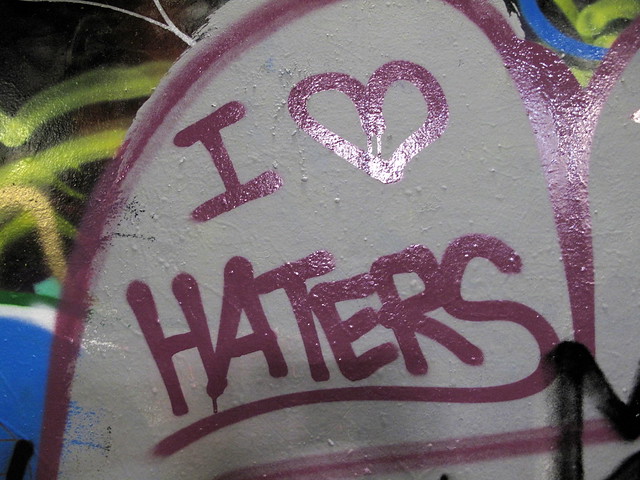
Haters Gonna Hate and Why You Should Love Them

Posted by 40deuce on 3:54 PM in , , , ,

Now that I'm working in the world of social media monitoring I hear and read a lot of stuff about sentiment. Mainly the talk is about negative sentiment. "We don't want people to say bad things about us", "What should I do if people are saying bad things about us?", "Here's how to deal with negative people", etc.

Now that everyone can have a voice on the internet they can also say whatever they want about whatever they want. Companies seem to have two main problems with this; a) they don't want people to say bad things in places where the entire world can see, and b) they're not sure what to do when people say something negative about them.

There's nothing you or anyone can do about the first one. People are going to speak bad about things all the time whether you're there or not, so you might as well be there. Get over that fear.

The second problem is going to have millions of answers for millions of different scenarios. The one thing that I will recommend you always do though is listen to what they're saying. Even if you're not going to respond, listen. The people who speak bad about you are your best critics in terms of constructive criticism.

Sometimes these people are just venting frustration about things, but sometimes these people are complaining because they think you're doing something wrong. Chances are if one person thinks it others do as well. If you listen to what these people are saying you're doing wrong, you have a basis to work off of on how to fix what you're doing.

When people tell you that you're doing something wrong it means that while they have something negative to say now, they're still paying attention to you. These people are part of your public, and social media in a corporate sense is about bringing together your public with your company. These people are paying attention to you but telling you they think you're doing something wrong. That means there's a good chance they want to pay attention to you and like what you're doing. By listening to these people you're getting insight into how to best reach your public in a positive way.

Some companies go for the quick fix. A quick response online apologizing and trying to make amends with a single person at a time. But, not everyone is always going to speak up. Like I said earlier, if one person has criticism of your company, chances are others are feeling the same way. Rather than respond to the ones that speak up one by one, listen to what they're saying and take it in to account when doing your next phase of planning. Don't buy people off, make them really like you by listening to what they say and take it into account.

Haters are always going to hate. People are always going to complain about something. You're not going to be able to change in response to every piece of criticism, but you are getting free input from the people that should matter to you.

Haters are gonna hate, but you should learn to embrace their hatred.

View Comments

My Search is Over!!

Posted by 40deuce on 9:35 AM in , ,


Apologies for not updating here in the past few weeks, but life has been a little crazy.

My best friend got married, I just moved into a new apartment, but most importantly I started a new job!!!

Yes, that's right folks, all my searching and hard work has paid off because I landed myself a new job that I'm super excited about!! I'm now the community manager for Sysomos, a company that makes social media monitoring software. This job is everything I was looking for. I get to do a perfect mix of PR and social media. I get to meet and talk to new people all day long about interesting things. What's not be excited about? Also, I really like the people at the company and the software, so this is going to be awesome!

Tomorrow morning on the Sysomos blog I'll be making my introduction to the community, so feel free to keep an eye out for that.

So, that's where I've been hiding, but now that I'm starting to settle in I'll be back posting here regularly again. Hopefully this new job wil give me even better inspiration for things to write about as well.

View Comments

Some Comments on Comments


I wanted to have this post up last week, but a few discussions around the topic with some people made me want to go back and reformulate it a bit.

The idea for this post started because of my last post. I was feeling kind of proud about it. I thought it was one of the more intellectual posts that I've written here. But then, no one really said anything about it. More than that, no one was commenting on it. Not that I want you to think I'm begging for comments, but something about it made me think people would have something to say about it, agreeing or disagreeing.

I mentioned something about it, which sparked a little conversation between me and some people on twitter.

A friend of mine (@joncrowley) says that sometimes when people don't comment it's because you succeeded at getting your point across well. No one has anything to add or disagree with in the post. This could be very true, but even so, perhaps that is something they could have said.

This reminded me of a blog post by another Toronto social media blogger, Dave Fleet, who wrote that Commenting Makes You Sexy. In his post he says that he enjoys getting comments of any sort on his blog because it gives him a chance to interact with and get to know his readers. He gets to know if they like what he writes, if they have something to add or if they disagree with what he has to say.

This is what every blogger should want. Feedback from your audience. That way you get to know what your audience likes that you write about and what they don't. With this information you can then write better for your audience. Seeing your posts get so many clicks is one way bloggers can know if their material is being well received, but it's not the the feed back of the actual words.

On the topic of click numbers, a former teacher and current friend of mine, Karen Snider, said that comments aren't the only measurement for blogs, and she's absolutely right. There all sorts of different types of measurement.

This topic also came up in Danny Brown's blog last week, The Metrics of Social Media. In the post he listed some ways in which companies can start measuring the success of their social media campaigns. Some examples I first picked out were things like "likes on facebook" or "views on youtube", and how these numbers also related to sales. Down in the comments though, began a great discussion of what ROI in social media means and how different measurements mean different things for different campaigns. I brought up the topic of public sentiment and we discussed how both a mix of sentiment and other numbers can be put together to find success (or to find out what doesn't work).

Again this is true. Especially when we're dealing with companies who are ultimately trying to turn their social media efforts into actual sales. The more numbers they have to look at, the more they can find out what their public really responds to and constantly improve to reach them better. These are the number they can gather both through analyzing sentiment and other web analytics.

In the end I came to the conclusion that comments can mean different things to different people. But they seem to come around to the same thing; gathering sentiment. Both companies and bloggers like to know what their publics think of what they are doing. This way they can both better get to know and improve for their audiences.

While comments are not everything, they are helpful and always good to see.

Any comments?


Copyright © 2009 A Geek in PR All rights reserved. Theme by Laptop Geek. | Bloggerized by FalconHive.